AI solved
how to build.
We solved
what to build.|
Product Console is the AI-native workspace where PMs think, write, and ship with their entire product history as context. Cursor for Product Managers.
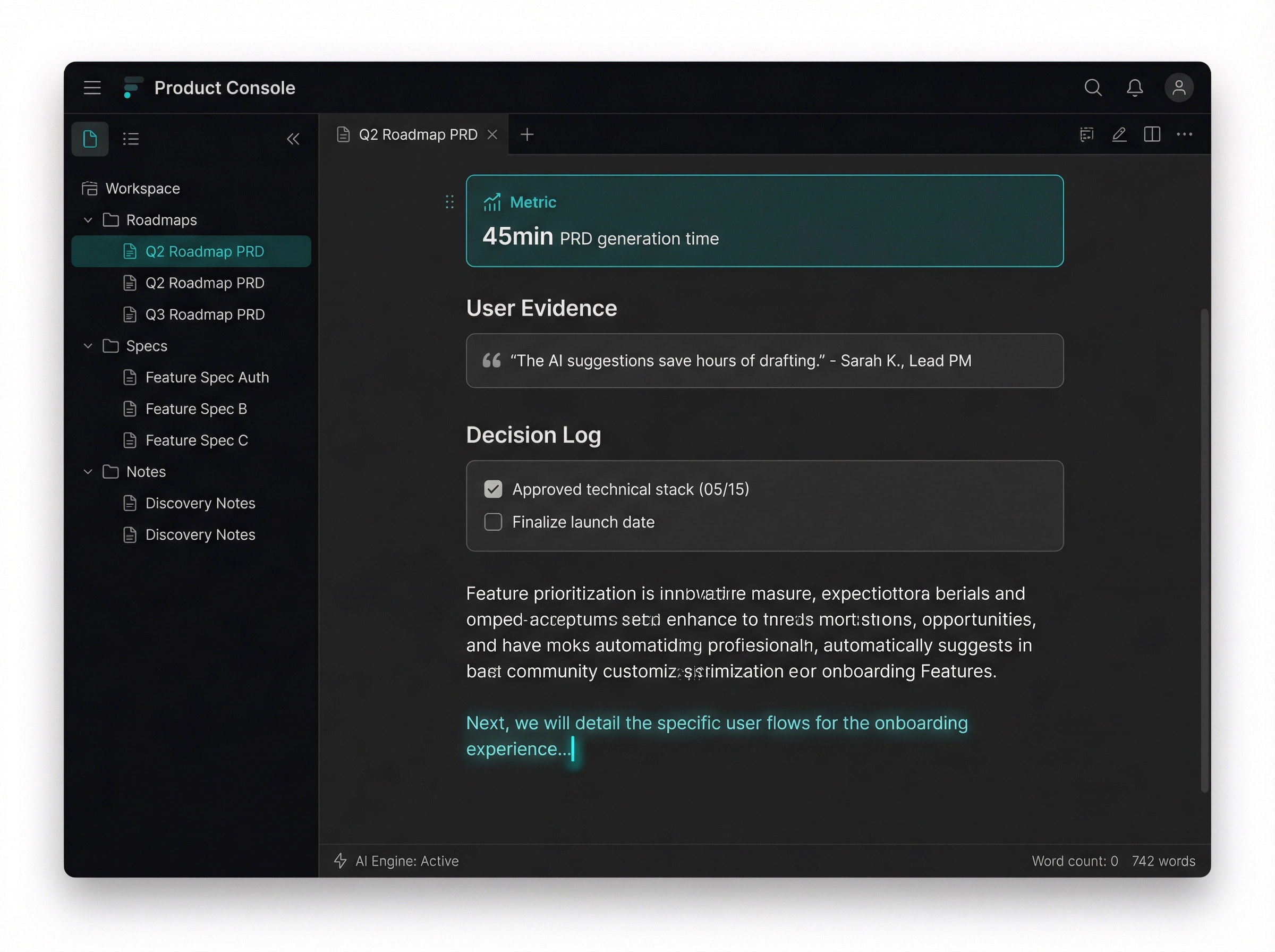
Write PRDs in 45 minutes with your entire product history as context.
Andrew Miklas (YC Partner) published "Cursor for Product Managers" as an official Request for Startups for S2026 — validating our exact thesis.
Live product at product-console.fly.dev with block editor, 4 PM-specific blocks, ghost text AI, inline commands, .pmrules configuration, and dark mode. Shipped March 2026.
Onboarding 20 design partners this quarter. Target: PMs managing 3–8 features per quarter at Series A–C SaaS companies.
Built for the people
who decide what ships.
Product Console is not a blank canvas. It has strong opinions about how product management should work — and it was built for the professionals who care about outcomes, not process.
Individual PM
Spending 4–8 hours on every PRD. Starting from scratch each time.
Write PRDs in under an hour with AI that already knows your product.
Phase 1 MVP shipped. Tab complete, inline commands, .pmrules for context.
Head of Product
Inconsistent quality across the team. Institutional knowledge lost when PMs leave.
Give every PM on your team the context of your best PM.
Knowledge Index ingests all artifacts. .pmrules enforce consistency.
Engineering Leader
Specs are incomplete. Requirements change mid-sprint with no trace.
Better inputs for your engineering team. Scope changes propagate automatically.
Composer syncs PRD, tickets, roadmap, and briefs from a single scope change.
Founder / Investor
PM tooling market is large but underserved by AI-native solutions.
Cursor proved the IDE model for developers. Product Console applies the same playbook to PMs.
YC S2026 RFS alignment. Phase 1 shipped. 5-phase growth plan to $500K ARR by Nov 2026.
Five compounding
layers.
Each makes the
next more powerful.
Most PM tools are forward-looking only. Product Console closes the loop — from discovery to decision to specification to outcome tracking to autonomous course correction.
$ product-console --mode=autonomous
→ Knowledge Index: 847 artifacts indexed
→ Drift Agent: monitoring 12 shipped features
→ 3 agents running in background...
Knowledge Index
Institutional MemoryThe Foundation
Every PM artifact your team produces — PRDs, customer interviews, feedback tickets, analytics exports, Slack discussions, and decision logs — ingested, embedded, and stored in a searchable knowledge graph. When you ask Product Console a question, it retrieves from your actual data, not a generic training set.
Artifact Engine
PRD GenerationThe Creation Layer
A PM-native editor with purpose-built block types: Metric, Decision Log, Dependency, and User Evidence. Ghost text (tab to accept), inline commands (/generate, /expand, /challenge, /simplify), and .pmrules configuration. Not a chatbot. A PM-native IDE.
.pmrulesComposer
Multi-Artifact SyncThe Synchronization Layer
Change scope on a feature once, and the Composer propagates that change across the PRD, the Jira tickets, the roadmap entry, and the stakeholder brief. Multi-artifact diff preview lets you review every downstream impact before committing. What Cursor Composer does for code, applied to PM work.
Feedback Loop
Outcome TrackingThe Intelligence Layer — Our Moat
When you ship a feature, Product Console tracks predicted metric impact against actual outcomes at T+30, T+60, and T+90 days. Over time, the system builds a model of what kinds of product bets work for your specific company, team, and market. Nobody else is building this.
Agent Layer
Autonomous AgentsThe Autonomy Layer
Three agents run continuously in the background. Discovery Agent surfaces patterns from connected sources. Sync Agent propagates scope changes automatically. Drift Agent monitors outcomes post-ship and generates Course Correction Briefs when metrics drift. Human-in-the-loop at every decision point.
From copilot to autonomous agent.
Cursor went from autocomplete to background agents that ship pull requests while you sleep. Product Console does the same for product decisions. Three agents. Always on. Human-in-the-loop at every decision point.
Discovery Agent
Phase 2Monitors connected sources — Slack channels, support tickets, analytics dashboards, user feedback forms. When three enterprise customers mention the same pain point in a week, it drafts a preliminary user story with evidence attached and pings the PM for review.
Sync Agent
Phase 2Watches for scope changes anywhere in the product stack. When a PM edits a PRD, the Sync Agent autonomously propagates changes to Jira tickets, roadmap items, stakeholder briefs, and Slack updates — then presents a consolidated diff for approval before anything is committed.
Drift Agent
Phase 3Runs on a schedule after every feature ships. Compares predicted metric impact from the PRD against actual outcomes at T+30, T+60, and T+90. When metrics drift beyond threshold, it autonomously generates a Course Correction Brief: what happened, why, and recommended next steps.
.pmrulesConfiguration file
The .pmrules file extends to cover agent permissions, drift thresholds, and notification preferences. Every team controls exactly how much autonomy they hand over — which actions run automatically, which require approval, and who gets notified when.
The category is being
rebuilt from scratch.
ChatPRD proved demand. Productboard proved market size. Neither is AI-native. Neither has agents. Product Console starts where they stop.
| Capability | ChatPRD 50K users, no memory | Productboard $1.725B, AI bolted on | Notion AI Generic writing assistant | Product Console AI-native workspace |
|---|---|---|---|---|
| Institutional Memory | ||||
| AI-Native Interface | ||||
| Multi-Artifact Sync | ||||
| Outcome Tracking | ||||
| Agentic Capabilities | ||||
| PM-Specific Blocks | ||||
| Context-Aware Generation |
Knowledge Index
Every day a team uses Product Console, the switching cost grows. A competitor starting tomorrow cannot replicate 18 months of product history.
Feedback Loop
The only PM tool that tracks predicted vs. actual metric impact. Over time, the system learns which bets work for your specific company.
Drift Agent
Completely unoccupied category. Autonomous outcome tracking with corrective action. Nobody else is building this.
Two founders.
We move fast.
Phase 1 shipped ahead of schedule. Built and deployed a working AI product in weeks, not months. We have been on both sides of the table — as investors and as builders.
Talal
CEO & Product
10 years in venture capital. YC alum who raised the largest seed at the highest valuation in his batch. Built and shipped multiple products across AI consulting, automotive, and transportation. Understands both sides of the table: what investors look for and what founders actually need to build.
Alexander
CTO & Engineering
Over a decade building complex banking and payments systems at N26, Deutsche Bank, and Naspay. Co-founded TAG with Talal. Built Execution Guard end-to-end on Elixir/Phoenix with PostgreSQL, pgvector, a knowledge graph, MCP server, web dashboard, and CLI.
Product Console will become the operating system for product management. Not a tool. Not a feature. The foundational layer that every PM works inside.
The way Figma became the default for designers. The way VS Code became the default for developers. In three years, when a PM opens Product Console, they will have access to every product decision their company has ever made, every metric outcome that followed, and an AI that understands the patterns between them.
More usage generates more indexed context
More context produces better AI suggestions
Better suggestions drive more usage
Switching cost increases — the product knows your org
At 1,000 teams, the dynamics change.
Public API
Teams read from and write to the Knowledge Index programmatically. CI/CD pipelines auto-generate changelog entries. Analytics tools push metric updates. The Knowledge Index becomes the central nervous system for product data.
Marketplace
Third-party PM frameworks, templates, and AI prompts. Teams share .pmrules configurations. Consultants publish best-practice artifact templates. The community builds on the platform.
Agent Marketplace
Teams share and publish custom agent workflows. A fintech team builds a Discovery Agent for regulatory feeds. A growth team publishes a Drift Agent tuned to activation metrics. Every published workflow deepens the network effect.
Integrations
Phase 1: Jira and Linear (bi-directional sync). Phase 2: Figma, Mixpanel, Amplitude. Phase 3: Slack bot, API, and custom webhooks. Every integration adds more data to the Knowledge Index.
"The end state is clear. Product Console becomes the single source of truth for product decisions."
Try Product ConsoleShape the tool that defines how PMs work.
We are onboarding 50 design partners this quarter. If you manage 3–8 features per quarter at a Series A–C SaaS company, this was built for you. Get early access and influence the roadmap.
Join the waitlist — we'll reach out directly.